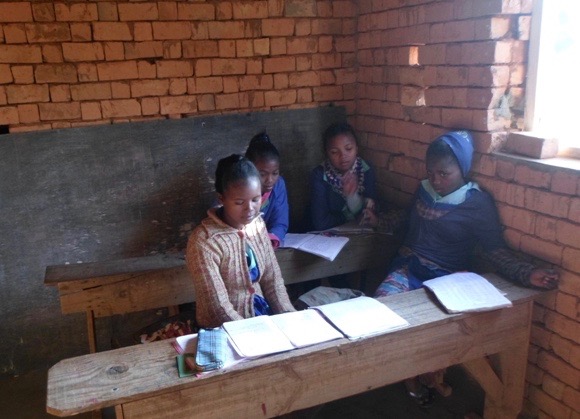
We believe that access to education is fundamental to life-long success. Many children in Madagascar, especially in rural areas, do not have access to a local school, or must leave school at an early age.
Madagascar Onboard seeks to strengthen access to quality education by supporting local projects focused on education.
Background
According to Unicef, most Malagasy children study in dilapidated and overcrowded classrooms with few learning materials. More than half of primary school teachers are recruited by parents’ associations and have limited or no training. Many communities have no schools at all.
Poverty increases the likelihood of children not attending school. Many Malagasy parents pull their kids out of school to help in the fields, with house work, or selling produce in the market. According to the World Bank, more than 70% of people in Madagascar now live below the national poverty line of $1 per day.
Getting a good education can be especially hard for girls. Education for girls may be less valued by parents who lack the financial means to send all of their children to school. Teenage pregnancy also prevents many Malagasy girls from completing their education. According to Unicef, 36% of Malagasy girls have a child by the age of 18.
Unicef found that the educational situation for girls varies greatly by region, but in some regions girls are much less likely to be enrolled in school than boys. In districts where the gender gap is greatest, there are barely 5 girls enrolled for every 10 boys. According to the Education Policy and Data Center, roughly 40% of high-school-age girls are not in school in Madagascar, and among the country’s poorest populations, as many as 60% of kids (both girls and boys) are not in school.
 Madagascar Onboard